The novel of Dune can be called ‘The Godfather’ of sci-fi. Just as The Godfather is not the first gangster film, yet had an undeniable impact on every gangster film since its release in 1972, so has the publication of Dune in 1965 irrevocably changed the landscape of sci-fi with its possibilities of myth-making. You may be unfamiliar with the story of Dune but if you enjoy Star Wars you will be familiar with it through osmosis. In the early seventies, George Lucas had initially tried to make an adaptation of Frank Herbert’s Dune, however upon failing to get the film rights he altered the story directing it at children instead ravenously plucking at enough references of Kurosawa and the old pulps to make a substantive mash of an IP. However it still has vestiges of that primal stage in its evolution. The Clone wars casually mentioned in A New Hope is borne out of the Butlerian jihad in Dune’s history. The Jedi, warrior monks with abilities to fight and manipulate using the power of voice were originally the Bene Gesserit, a feared sect of warrior nuns with the power to manipulate people with their voice. The list goes on. So for a youngster of the current generation to view a film of Dune might not result in much fresh or original ideas since the majority of ideas it has already been so well mined for ideas since its the 60s forever altering the literary landscape with massive tectonic shifts.

I am a reader of the first four Dune books by Frank Herbert, and having lived with them for many years, as well as having watched Lynch’s 1984 Dune, I did not come to this new Denis Villeneuve version as a fresh viewer. I carry decades of baggage and I am pleased to say that the first part of Dune did not disappoint. It did not blow my socks off either.
I did instantly recognise it as a considerable film. I’m writing this review after my second viewing. The first was when it was released in 2021, releasing all too hurriedly to streaming where I caught it. And while most of my thoughts in this review remain the same, I must say Dune is one of those films that is a very different experience on an Imax screen with the Dolby Atmos prickling the air around you as the sand ripples, and a sand worm the size of the Empire State building comes rumbling at your face.
Denis Villeneuve is a remarkable filmmaker I have a great deal of respect for. I’ve watched most of his films, beginning with Incendies. It is difficult for that film not to leave an impression on a viewer. Later I saw Arrival, a deeply flawed masterful film of atmosphere. Flawed because of its cowardly abandonment of the most important part of the story – how the alien language at the heart of the story is deciphered, choosing instead to lean on insipid twists. His next work, Blade Runner 2049 is my favourite of his films, certainly outdoing the original which suffered weak plotting and writing. The 1982 Blade Runner is do doubt a historical landmark for its visual effects, design, cinematography and design, but the story never did much for me. 2017’s Blade Runner 2049 on the other hand, worked on all those levels, while also being effective in telling an intriguing noir tale. I then saw his worthy watch of an unnerving film Enemy. So when it came to Dune I had very high hopes for this filmmaker who had shown he was capable of working on a landmark Sci-fi IP with all the pressures that comes with it along with intense drama.
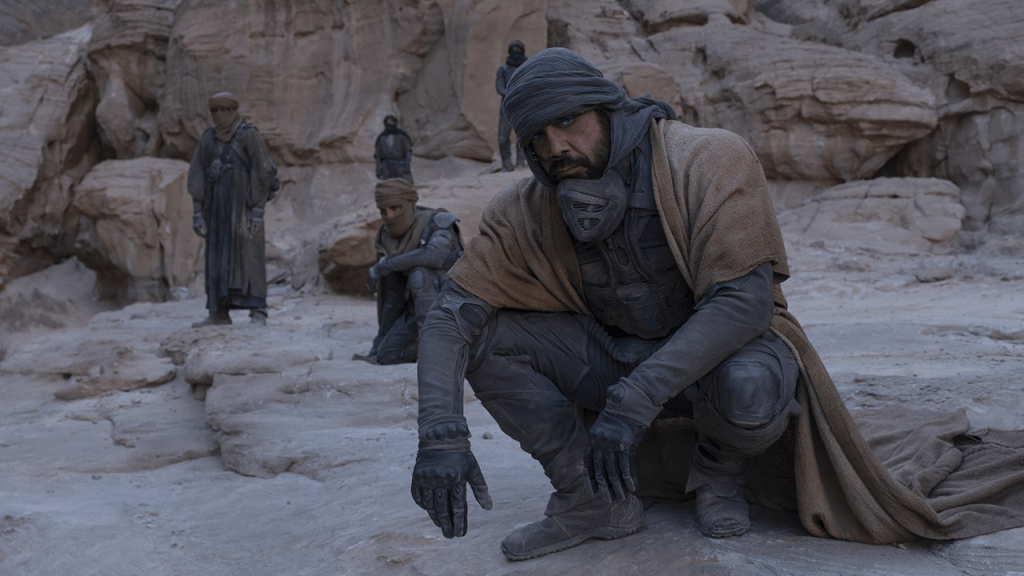
The 2021 film Dune part 1 is successful in its mission to adapt Dune, for the most part. Denis Villeneuve takes great pains to juggle a universe that feels fresh while at the same time feeling lived in for thousands of years, while managing the impressive feat of having its own unique aesthetic. Nobody will watch this film and mistake it for Star Wars or Star Trek or Transformers. Grieg Fraser’s cinematography is crisp. Not as painterly as Roger Deakins’ in Blade Runner 2049, but suitable for this universe and it does not feel lacking in the least. Hans Zimmer’s (Gladiator, Dark knight, Inception, Pirates of the Caribbean) score does the same thing the art and costume design does. It takes the influence of a diverse array of cultures, mushes them into a haunting whole while at the same time being modern and unique. If you have heard this score once, you are not likely to mistake it for any other score if you should happen to come across it in passing. Except perhaps phrases of the electric guitar riffs from Hans Zimmer’s own Man of Steel score. And there’s nothing wrong with having a style of one’s own.
The casting is superb across the board. If anything my only fault would be that everyone of these amazing actors doesn’t get enough screen time to live more in their characters, because of the sheer size of the story that has to be condensed; yes, the first book has been split into two almost 3 hour films; and that still demands abridgement. Which brings me to the writing. The writing does an admirable job of introducing a plethora of strangely named weird looking characters most of who play vital roles at various points in the story. Villeneuve and crew achieve part of the task in their excellent casting, while the writing shows it is wise enough to understand which plot threads need room to breathe and which only need to be touched upon, no more, in order to keep the pace going. The 1984 Dune suffered in that regard. From the get go it felt burdened by the task ahead. A character stares out at us and proceeds to spell out the layout of the political intrigue infecting the galaxy, which planets are involved, who the vital players are and so on. Producer Dino De Laurentiis has never been accused of having a knack for storytelling. After all this was the man who fired John Millius from the sequels of 1982’s beautiful Conan the Barbarian, a crime for which he will forever be relegated to the top of my Film naughty list. 2021’s Dune part 1 had the foresight to split the massive story. But here lies the quandary. Where does one split a single story? At a cliffhanger? At a shift in tone? At a point of growth for the character? Well, the first time I watched Dune in 2021 it appeared to end more abruptly than I would have liked. I was left unsatisfied, undoing the past 3 hours of world and character building. I’ll have to watch the upcoming part 2 to determine if there might have been a better place to split the story and I’ll address that aspect in my review then.
In part 1, Villeneuve and his co-writers make a dismal choice. It is not terrible. But it alone brings down any rating of the film. Although I must admit that watching the film for the second time, this time on an Imax screen it did not strike me as that anti-climactic. This is one of those films that is elevated by the theatre-going experience, unlike most where you feel no difference with watching it in HD or 4K in the comfort of your home rather than a theatre screen. Vlleneuve’s Dune is a sensory experience. Much like Nolan takes great pains to have his films become. However, while Nolan’s film have taken to dip in the effectiveness of his storytelling by depending on his dump and dash formula, Villenue’s Dune unfurls itself as it should – like a majestic bird of prey taking flight. Every scene is well done in terms of direction and editing. However, unlike Nolan, Villeneuve does have a tendency here to miss the heights of emotion pitch required in certain rare scenes. There are five such scenes in the film, each of which could be fixed with the addition of barely a couple of seconds, usually one or two brief missing moments that felt so incredibly necessary. Three of the most quilty scenes are Gurney Halleck’s final scene of action, the same for Duncan Idaho’s, along with Paul’s duel at the end. As these scenes were playing out the absence of these vital moments, like notes missing from melody made me wince. So close! By missing moments I am not referring to items missing from the books. On the contrary, I am all for altering works in adaptation to best suit the story. In that spirit, if these five scenes had their missing moments I would have rated the film at 95%, which in my book is a perfect score. A perfect score does not mean there must be a consensus of its quality. It simply means that it had all the ingredients in the right measure for me to thoroughly enjoy this particular story. However, the 2021 Dune Part 1 might score around 90%, which is clearly pretty high.
Obviously, having read the books, though it’s been a couple of decades, I know how the story will unfold in the coming parts, but just as knowing the words to a song doesn’t deprive one of enjoyment on future listens, it will not hinder my enjoyment of these films. In most cases it heightens my enjoyment as it did here. And with the release of the second part imminent, I am not afraid of being disappointed anymore. Not only because I know it is in good hands, but also because in times of trouble I repeat to myself: I must not fear. Fear is the mind-killer.


Leave a Reply