2019’s sci-fi epic Ad Astra is a classic film that tripped and fell down a well.
I came to the film a couple of years after its theatrical release because I had gotten it confused with First man, both released within months of one another with overlapping publicity and similar posters – both showing dour helmeted astronauts. So when I finally began watching Ad Astra I was pleasantly surprised to find that it was not dealing with the well trodden story of the Apollo missions, but instead was an original sci-fi set in the near future. I use “original” tentatively because within minutes it becomes obvious to any film-literate viewer that it follows Apocalypse Now conspicuously closely. From the whispered monotone of Brad Pitt’s narration, to the secret mission he must make in a supply craft to a secluded location with a novice crew in order to stop a mad man. However, though I sensed this early on, I didn’t mind the similarity – because it was done well (A cure-all for most cinema sins)!

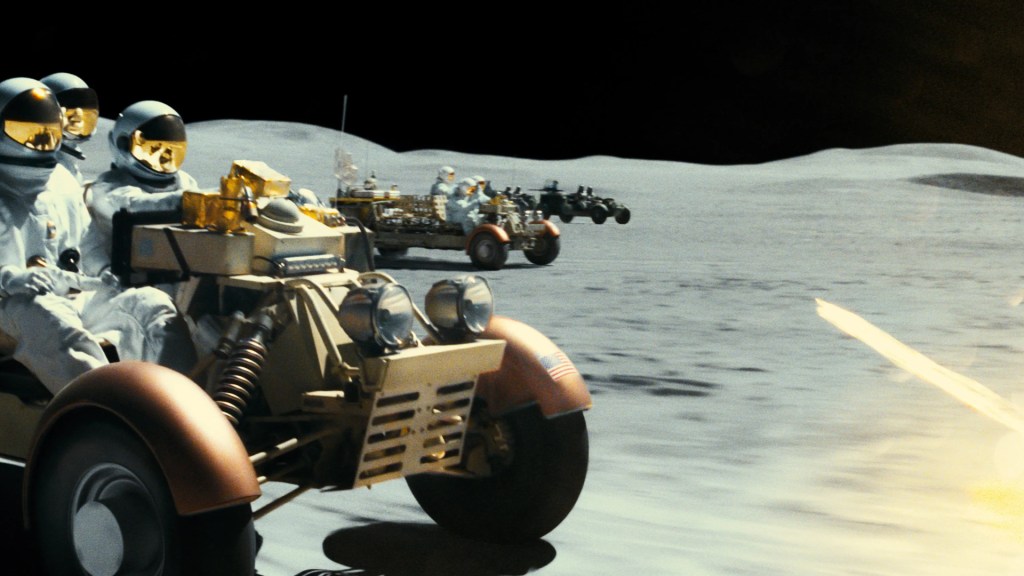
Each successive sequence is memorable and finely crafted. The disaster on the high altitude tower to the gun battle on the moon to the treacherous stop midway to Mars. The film features some of Hoyte Van Hoytema’s best cinematography. His Nolan efforts have always felt handicapped as poor imitations of a style crafted to perfection by another master (Wally Pfister), while here he was allowed to be his own man and use the black values and contrast levels as he saw fit. The editing is superb, not afraid to rest on images or cut rapidly as needed. I was drawn in by the methodical momentum of James Gray’s directing and writing, and it was capped off by a suitably stoic performance from Brad Pitt.
What makes his performance so striking is a rare movie star quality he displays here. Halfway through the film, during the break I even remarked to my companion how much Pitt’s movie star persona radiated from the screen and how rare that was these days with the newer generation of actors and actresses lacking it. Don’t get me wrong. There are, no doubt, some very popular performers, regardless of sex. But very few to none seem to be able to walk into a room with the ability to pull every eye to them.
Like Apocalypse Now, Ad Astra is a linear sequence of episodes encompassing a journey. Point A is Earth and Point B is the outer reaches of the Solar system. We arrive on Mars midway through the film, and this is precisely when the film suffers its fatal tripping, and takes that dismal plunge into the void.
Rumours abound of Ad Astra’s reshoots, that the films co-writer and director James Gray had accused the studio of crippling the film, though he has since denied any mandated re-shoots having taken place. It is not mysterious why a profession might choose to hold their tongue. And perhaps it is the right choice since he is after all still directing main stream films while others who have spoken out are rarely heard from again. However, I would love to watch his original take of the second half of the film, for the sake of comparing as a purely storytelling exercise. After all James Gray’s films are famous for having weak third acts. His projects have promising premises with little to no substantive payoff. I can never tell whether he is doing it for art’s sake or is just incapable of thinking of the ideal conclusion.
The problem starts all the way back at that midway mark on the Mars base where the impetus of Brad Pitt’s character is thrown for a loop by disregarding everything established so far about him and what follows is an adolescent realisation of an action film. From this point, Ad Astra takes a dive into mediocrity for the same reason that most who quote the Latin phrase Ad Astra do. It means “to the stars” – but it is incomplete. The complete phrase goes – “Per Asperum Ad Astra” meaning “Through hard work, to the stars.” And that is precisely what James Gray’s films stumble, trip and fall. He doesn’t put in the hard (brain) work to iron out the problems in the story. So then by the time the film ends, instead of a big bang the audience is left with an annoying whimper.
 Shot by Shot Reviews of Film and TV
Leave a comment