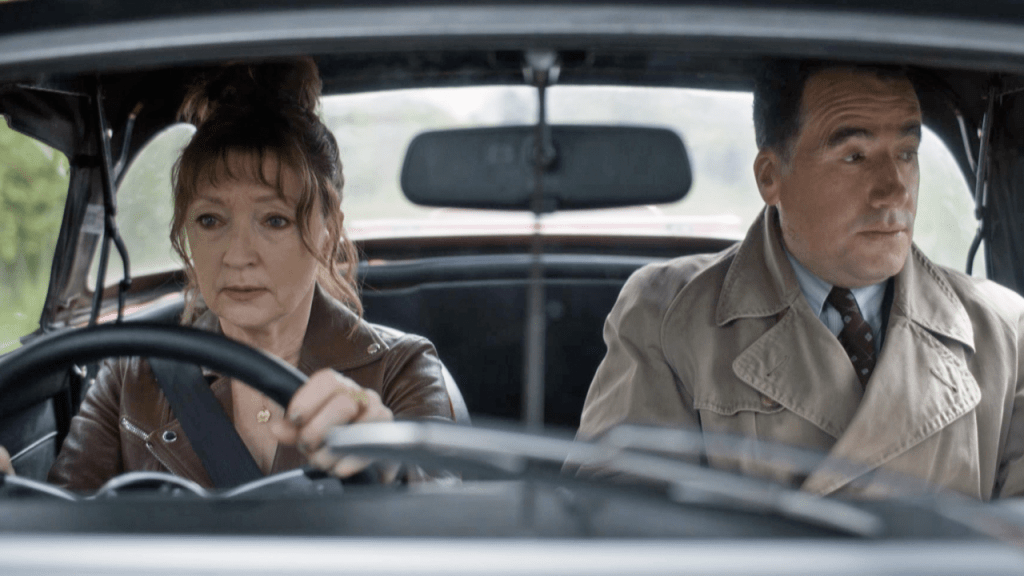
Magpie Murders is a 6-part miniseries in the vein of British TV from the 70s, 80s and 90s where a book would be adapted into a limited series à la Shogun or Roots. However, Mapgie Murders has the novel distinction of being adapted by the novelist himself, which is a rarity. Having built up a significant reputation in the YA literary sphere Anthony Horowitz has joined the ranks of the select few with that achievement, including Gaiman and, er… I can’t think of any others.
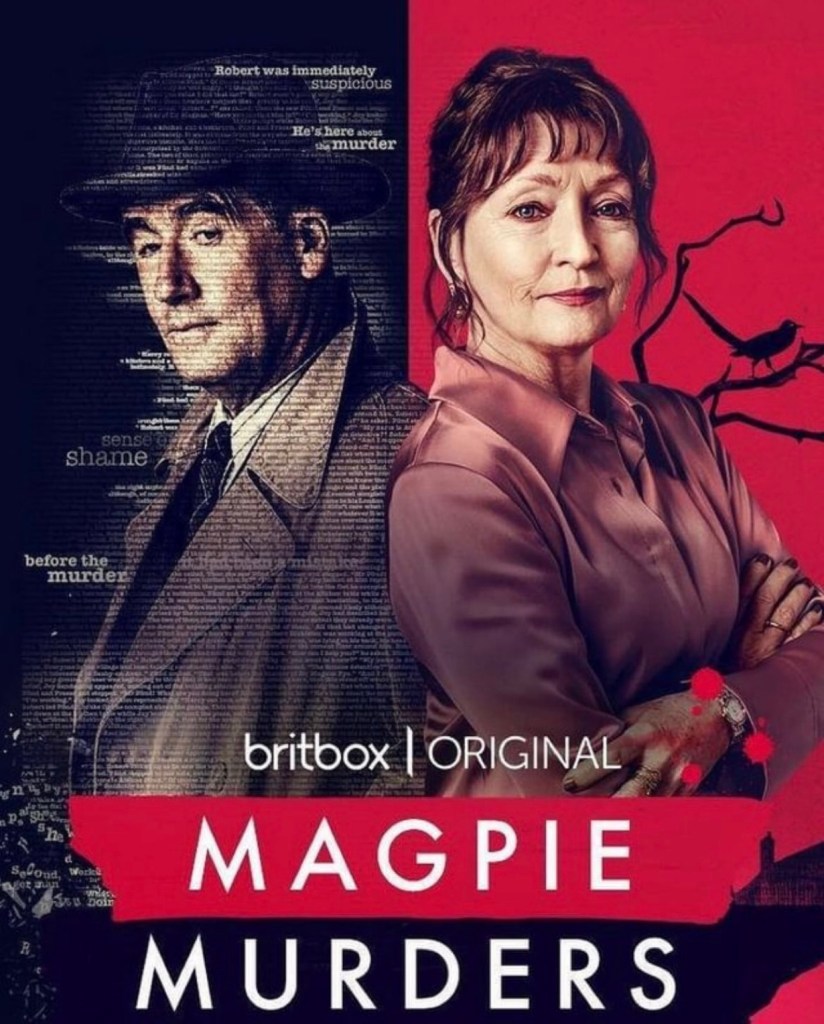
The best thing I can say for the show is that it plays out very much in the leisurely pace of a novel, with meandering plot lines constructed to distract and misdirect the viewer. Among the show’s strongest features is its protagonist, a book editor, unusual. Susan Ryeland, played by Lesley Manville, can be charming when she needs to be, and at times is obstinate to the point of irrational. It is refreshing to watch a show from the perspective of a mature person for a change, that too one who is still trying to figure things out.
The story kicks off with the sudden death of bestselling mystery novelist Alan Conway who has just delivered his latest whodunit to his publisher, but uh oh, it’s missing the last chapter. Susan, his editor, goes on the hunt for it and along the way discovers foul play in the author’s apparent suicide.
Conleth Hill, who plays the diseased Author, is a welcome face from Game Of Thrones and more recently Vienna Blood set in Freud-era Vienna where he plays the father of a mystery solving psychologist played by Matthew Beard, who conversely appears here as the Author’s lover. It’s fun seeing them together again with a whole other dynamic.
Magpie Murders has two parallel story lines running concurrently, the death of the writer (set in the present) along with the mystery that is missing its solution in the incomplete novel (set in the 1950s). The hero of the novel is the brilliant Atticus Pund, a German private detective played remarkably like a character who has stepped out of a page from Tintin, both in looks and demeanour. Tim McMullan looks familiar, so I must have seen him elsewhere, is the highlight of the show. I hope to see him in more leading roles because he certainly has the charm and the charisma of stillness to carry it off.
Having mentioned the highlight, we must come to the show’s drawbacks. Style. Or lack there of. In fact it falls short in almost all the technical aspects, utterly wasting the contrast between time periods; these distinct costumes and polished cars might as well be dust bunnies in the corner. There is almost an entire episode, I think the 5th and some of the 6th, where the mask used to create the vignetting on the top left corner and along the bottom edge of the picture shows itself like a stain with a pronounced outline. I can’t recall this happening with any other shows in my experience. It is surprisingly sloppy for a UK production.
Returning to the writing, beyond the superficial distinction of the parallel mysteries that are tangentially connected, Magpie murders has all the mainstays of a standard whodunit. So if you’re looking for easy watching this is a decent example, with the mystery concluding in 6 episodes.
The conclusion, or the solution to a mystery is emphasized for much of the runtime of a show dealing with publishing. As the main character, a book editor, states, “There is nothing more useless than a whodunit with no solution.” And ironically, the solution is Magpie Murders’ weakest element.
It irritates me when I, as an audience member, am meant to go with characters behaving illogically or, just as bad, counter to their established characterization. It is worse in a whodunit which is ideally built using logical blocks. Logical inconsistency create fissures which add up until they ultimately bring the whole thing crumbling down.
Without giving away spoilers, our protagonist solves the murder in the end, which shouldn’t come as a spoiler. She has successfully identified the murderer, and their reasoning, but what does she do with this information? She confronts the murderer. That’s the way murder mysteries play out. However, she does this by herself, in private, and on top of that keeps turning her back to the killer as though she was having a casual chat. This is not a police officer or even an amateur detective. This is a cloistered book editor who has stumbled into solving a murder mystery. It was totally unbelievable. I understand there is another miniseries with the same characters out this year. I will check it out for more Pund, with the hope that the solution doesn’t cramp the whole experience yet again.
The climactic confrontation for Magpie Murders is horribly done. I am fine with who turns out to be the killer, but when the murder is explained there is just a dash too much plot convenience for my taste. I have not read anything by Horowitz so I am not familiar with the quality of his plotting otherwise, but since he adapted his own novel here the responsibility for the slip-up is entirely his. Whatever the reason behind it – it does not work. Fix that climax and the miniseries becomes a pleasant watch. Unfortunately, in its current avatar, it is the solution that kills this whodunit.
 Shot by Shot Reviews of Film and TV
Leave a comment