
Is quirk for quirk’s sake, more a hurdle than an aid in telling a story? It is a fine balance to be struck and takes a filmmaker of persistent voice, rather than a persistent vision. The difference there is that one’s vision for a film can shift from project to project, however that filmmaker will not be capable of removing all traces of their unique voice from leaving a trail through their work like a slug’s sticky streak. Examples of these filmmaker’s range from Fellini to Wertmuller to Jeunet to Burton to Lynch to Miike. Truffaut’s Jules et Jim is a quirky technique manufactured for a single film. The world it represents is not quirky. It is charming yet very real. Poor Things is quirk upon quirk upon quirk with no vision. It has no voice. It is a finely polished trumpet without Louis Armstrong attached. It is a pretty object, devoid of creative spark. Which is not to say that Poor Things is not bubbling over with invention. There are lenses employed in this film I have rarely, if ever, seen used in a mainstream film. There is use of sumptuous colour and nostalgic black and white. There are sets dressed with undreamed of objects. Chimeras of domestic animals achieved in a wholly convincing manner with stunning use of cgi. It proudly chirps with inspired performances from the likes of Willem Defoe, Emma Stone, Mark Ruffalo (giving the highlight comedic performance that made this film close to tolerable). There is even an appearance by the great Hanna Schygulla, criminal to be wasted with no more than a cameo. However each of these finely executed layers of quirk are piled one atop the other and unsurprisingly the pile begins to weigh itself down and the viewer realises there is no purpose to the quirk.
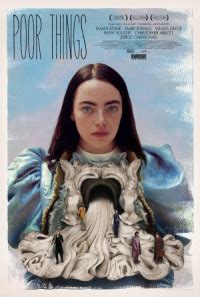
Poor things is the story of Bella Baxter, a human being crafted by a scientist, with the quirky twist that the scientist is the disfigured, scarred and tortured soul. While his creation is an almost blemish free Emma stone in all her porcelain glory. As the film progresses her child-like mind develops, learning and growing with experience into a fully formed human being. This would have been the ideal course for the story. Indeed, the majority of her journey has her stumbling from one episode to the next with her unformed mind trying to grasp the absurdity of society’s rules and obligations, which is entertaining, be it in Forrest Gump, Edward Scissorhands, Bicentennial Man, Being There, the list goes on. Unfortunately, or fortunately, for Forrest Gump, he is the person that he is. All he can do is try his best to navigate the trappings of society. Chaplin’s tramp is much the same. So is Mr Bean. And, in each of these instances, we conclude on the same vital point – that even with their “shortcomings” their selflessness shines as they plunge without hesitation to help someone in need or the less fortunate. In Poor Things, Emma Stone’s Bella Baxter does the opposite.
We are shown an example of her desperation to help the poverty stricken population of a distant island. But she is naive. She gives away all the money she can get her hands on only to have it all stolen. She is unaware of the theft. Regardless, this entire segment has a point it is trying to make for the audience. It lasts less than five minutes, and it is there to tell us – it is pointless to help others. That’s that.
Why her character needed to travel outside of Victorian London to discover poverty when the city had its own share is beyond me. This is followed by her learning the virtue of self-dependence by stumbling into becoming a very successful (and cheap) prostitute. Again, why she had to go to Paris for this development is beyond me when by some estimates Victorian London, with its population of 2 million, had around 80,000 women in the profession, either full time or part time. Whether that number is exaggerated or not, it shows the lack of thought put into the film by its makers. I am not judging the novel it was based on because I have not read it. Regardless, the lesson Bella Baxter learns is a self serving one. The last third of the film becomes a gospel promoting Ayn Rand’s philosophy of Objectivism.
That the elite of Business, Banking and the Arts are disciples of Objectivism is not a secret. Why they might feel that way is also not a mystery. However, why they feel the need to build shrines to Ayn Rand seems oddly public minded for a philosophy that rejects the morality of altruism. And to spread the word of Rand is the purpose of Poor Things, the film. Make no mistake about it.
The film tantalises with distinct visuals, odd ideas and loads of screen-time of a nude Emma Stone shown in all her glory yet oddly without a hint of eroticism. I am not sure how they managed to remove all desire for what we are seeing considering Emma Stone is a very attractive and charismatic actress. However, beyond that impressive paradox, the nudity does not seem to serve any function in the story.
In his travels, Forrest Gump collects an assortment of friends from different walks of life whom he has affected positively in some form. Poor things concludes with a handful of people Bella Baxter has collected. Not all friends. Why? What point is being made when even her tormentor makes an appearance, punished in keeping with the grotesque ending of the 1933 ‘Freaks.’ That film had the attitude of a horror film and the ending was meant to shock. Here, are we meant to chuckle that a man’s brain has been switched with that of a goat’s, so that now and forever more he will be kept as her helpless pet?
At first I assumed the title Poor Things referred to the helpless animals that are the subject of experiments under the hands of the scientist played by Willem Defoe. As the film progressed I assumed it referred to the likes of Bella Baxter, who is, in the beginning, a helpless plaything of society. Then I thought the title pointed to the poverty stricken people of the world. Then I thought it referred to women in general for suffering under the rule of men. My final conclusion? It referred to the men in the story. Her father dies horribly. Her fiancé is made to submissively stand by her while she freely explores her sexuality with others. Her tormentor is made a goat. Her ex-lover is driven half-mad with jealousy.
At one point, Bella asks her Fiancé, ‘Does the whoring thing challenge the desire for ownership that men have?’
I honestly cannot tell whether it is the film making a bad point or the flaw in the character’s point of view due to her limited experience of the world. The film is rife with these absurdities that any adult watching would see through.
Which is why, and I’m not sure whether this is a compliment or an insult, Poor Things has the distinction of feeling like a product spit out by AI. The characters, the dialogue, the design of the film are all quirky, but without authorship. A Tim Burton film like Batman, Edward Scissorhands, Batman Returns, has the feeling that it has a distinct mind filtering the various departments towards a singular vision. Poor Things, in contrast, feels arbitrary. And arbitrary is not a creative choice. It is a lack of commitment.
Besides the film’s quirky ships, the floors, walls and ceilings are not spared this fate. The choice and use of lenses at focus lengths ranging from extreme fish eye to zooms to telephotos within a single scene without any call for them. One might argue, ‘ah, but that’s the vision of director Yorgos Lanthimos, the maker of Dogtooth and The Lobster, other quirky films. So how can you discount it?’ I’m not discounting it. I am only telling you that in this instance it did not feel like something constructed with creative intent. I suppose that can be a compliment if it is meant to seem ‘other worldly.’ You might say it is meant to be a dream, constructed by Bella’s disjointed mind, but then why doesn’t it adhere closer to reality as she matures? Why is the world exactly the same at the end as it is in the beginning?
When Poor Things began, with its shifting lenses and traipses from colour to black and white I gave it the benefit of the doubt that the narrative intention would be revealed. There had to be some purpose for it. There is some reason why the sky is pearlescent. Why the ships appear jumbled. Is it the world as seen by Bella Baxter’s brain as a result of the experiment? I went into Poor Things familiar with the previous work of Director Yorgos Lanthimos. I had enjoyed The Lobster to some extent; a quirky effort that I appreciated. And though I watched Dogtooth when it was released, I remember almost nothing of it. So I put my faith in his hands once more. And by the end Lanthimos had let me down. Arbitrary design choices is a choice. But it is not an artistic one. And that was when I understood – that the title Poor Things was referring to me, and others like me who had put our faith in the hands of the filmmaker to give us some respect in turn. And he gives us nothing. That is the problem with Poor Things in a lamp shade (arbitrary choice).
 Shot by Shot Reviews of Film and TV
Leave a comment