*Oscar Winner – Best International Feature Film
Sometimes a film will leave you with an image or two that can, by themselves, be more satisfying, than a complexly plotted film or a big budget extravaganza taking you to the stars. The images are not “beautiful pictures.” They resonate, and they are designed to resonate. It isn’t an accident that I walked away with these images. I bet quite a few who saw this film and enjoyed it would have these same images sticking to their minds. What are they? To share them would be to spill the beans. To share them would be to speak aloud a wish. It might float away if I do, and I can’t have that.

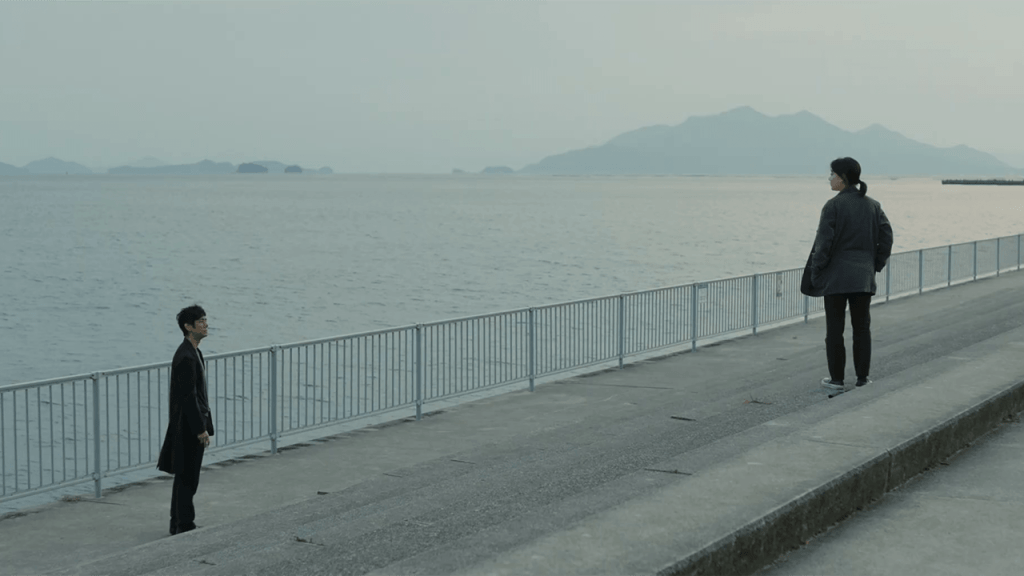
Drive My Car, much like the main character, Yūsuke’s, long drive from his hotel to the theatre, takes its time, and it takes the scenic route to get there. For instance it is only after the first 45 minutes that we see the opening credits in this almost 3 hour film. In terms of its aesthetics (colour, look and feel) it reminds me in the best ways of some of my favourite Japanese films from the nineties and early 2000s. So much so that one wonders whether that is how Japan appears “visually”. Contrite concrete, near-empty streets and cities, the sea lingering outside windows…
It is the ideal antidote to the Hollywood film fast food burger. There is no plot. Drive My Car gives you a half of a bun, followed by another half of a bun, followed by a patty of your choice, followed by a garnish, followed by a piece of bun, followed by a patty, followed by a cool drink, followed by a patty. Needless to say you leave satisfied because you got all that you wanted, and of course those evocative images. They drive any notions of burgers from one’s mind. Because the film did more than fill your stomach. Anything can do that. It didn’t even have to be good. Because there are those occasional films that make you think, or feel, or understand, and Drive My Car makes you dreamily wonder about life, while the landscape slides by outside on your way to the hotel on a distant island off Hiroshima bay.
Having heaped on that praise I must admit the film suffers in its last quarter. It is an adaptation of a Murakami short story, so perhaps it had no choice but to follow the course of the original, especially with such a lofty name associated to it. I suppose most would have considered any deviation a cardinal sin. I am not of the view that adaptations needs to follow the source material to the letter. The best adaptations are those that are adapted to best fit the new medium.
In the second half, there is a long thought-provoking monologue given to the main character. It is three characters in a car. It is done well and to good effect. However, what follows is more monologues, with sort of a desperation to tie up all the threads before the film winds to a close, betraying the charm of its ambiguity thus far that had drawn the viewer in. Not every little thing needs to be explained to the viewer, and that too at length! On top of which, there are probably more lines from the Chekhov play Uncle Vanya in the film than original dialogue spoken by the characters. True, it is as central to the story as the main character but it is a shade bit overused so by the time the film arrives at the climactic scene, rather than me being absorbed in the touching performance expressing Chekhov’s profound prose, I found my mind distracted because the mistake made here is that so much of that play has been played out by this point that as one new to Uncle Vanya I was preoccupied in my effort of piecing those slices together than really in what it meant to Drive My Car. There are better ways the play could have been employed to get the necessary effect for the uses in the story. Much like Amadeus employed Mozart’s music to great effect without dunking us in it the entire way through. The play is used here with the same function, unfortunately it’s over-usage weighs down the film rather than its greatness lending some buoyancy to it.
The last quarter felt hurried, not in the screen time but in the execution, both of the writing and the film-making. As though the creators were now bored with it and wanted to head off to do other things. As a film goer one doesn’t want to feel like an unwanted guest. The main course is done. Here is your dessert, eat it quickly and get out. That is a damper no matter how enjoyable the rest of the night might have been, and the film deserves better than that. We, the viewers, deserve better. Perhaps it was a lack of stamina, though Murakami being an avid long distance runner should have known how to pace himself better. And the filmmaker’s should have had the guts to fix his mistakes, and drive the car in an otherwise wonderful excursion to the coast of Hiroshima, while giving us lovely insightful peeks into the process of a stage production being raised from the ground up. Unfortunately as a film, it does not shift from third to fourth gear, thus never quite opening up for the drive of a lifetime it very well might have been.
 Shot by Shot Reviews of Film and TV
Leave a comment