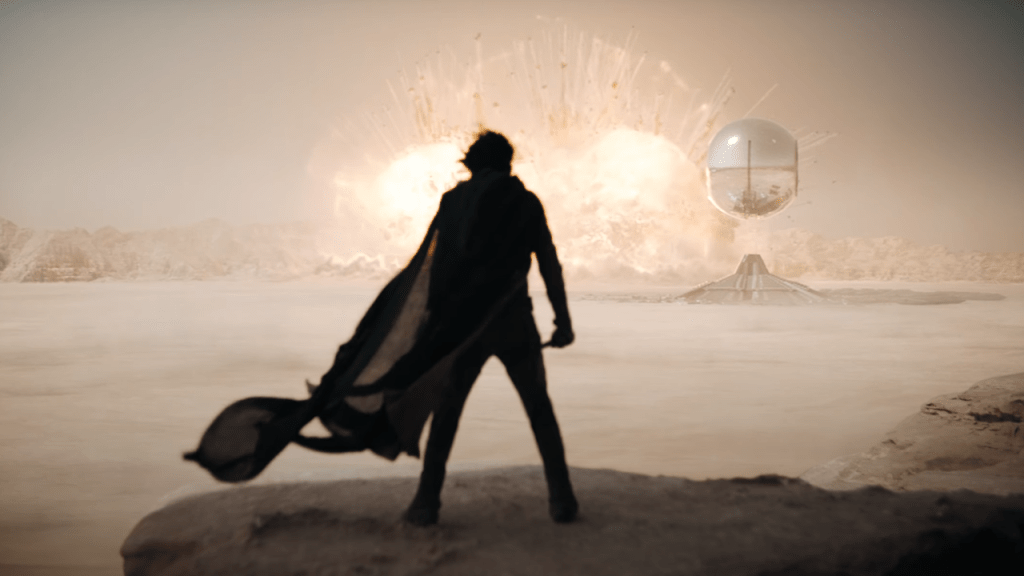
Dune Part 2 is a revolution. Dune Part 2 is a revelation. Dune Part 2 achieves all that it sets out to do, as the second installment in a grander story.
Working my way in from the outside, all the performances here work together to elevate the story beyond other fantasy Films and TV series. Timothee Chalamet as Paul Atreides is a definite highlight, no longer the boy but a young man leading an army, standing toe to toe against actors of vast experience and stature like Javier Bardem and Josh Brolin. The cinematography, though it does not astonish, never falters and is a top-notch dance partner to the narrative. The seams in the editing does show on a couple of instances when it is juggling a story thread too many within the limitations of cinematic storytelling. The problem comes from the ecstasy itself – of covering a galaxy expansive story comprising over half a dozen character threads. The script of course is driving that ambition and the spontaneous round of applause at my cinema as the end credits rolled was well-earned by the mammoth effort.
Arriving at the heart of the story, Frank Herbert modeled the character in the original novel of Dune on T. E. Lawrence, aka Lawrence of Arabia, the lowly British army officer (Intelligence operative in reality) who the press of the 1910s lionized as the “uncrowned king of Arabia” for bringing together the warring Arab tribes to fight their common foe (coincidentally a foe of the British Empire as well) – the Ottoman Empire. David Lean’s masterpiece Lawrence of Arabia takes 3 and a half hours to cover that narrative. Dune Part 2 does it in 2 and a half hours, on top of which it includes a competent love story. And, Dune Part 2 takes Lawrence’s journey one giant leap further. Here, Lawrence does not stop with the capture of Damascus, but challenges King George V himself. Having re-watched the first part of Dune on its re-release 3 weeks ago (read my review) I can tell you that these films work best in tandem. Though time will tell whether they can work as well as standalone films like The Godfather and The Godfather Part 2 or The Terminator and Terminator 2 or will they instead function like the Peter Jackson The Lord of the Rings trilogy, forever part and parcel with one another, which is no failure since that is clearly their purpose.
Denis Villeneuve’s direction in Dune Part 2 oozes with the charisma of confidence. Dune Part 1’s methodical pacing works for the first act that covers a couple of weeks (it seems). By Dune Part 2 the story, in its second act, is being carried swiftly along by its current and covers months effortlessly. I will contend that if the US Writer’s and Actor’s Guild strikes of 2023 had not delayed its release to 2024 he would have been a strong contender for the Best Director Oscar.
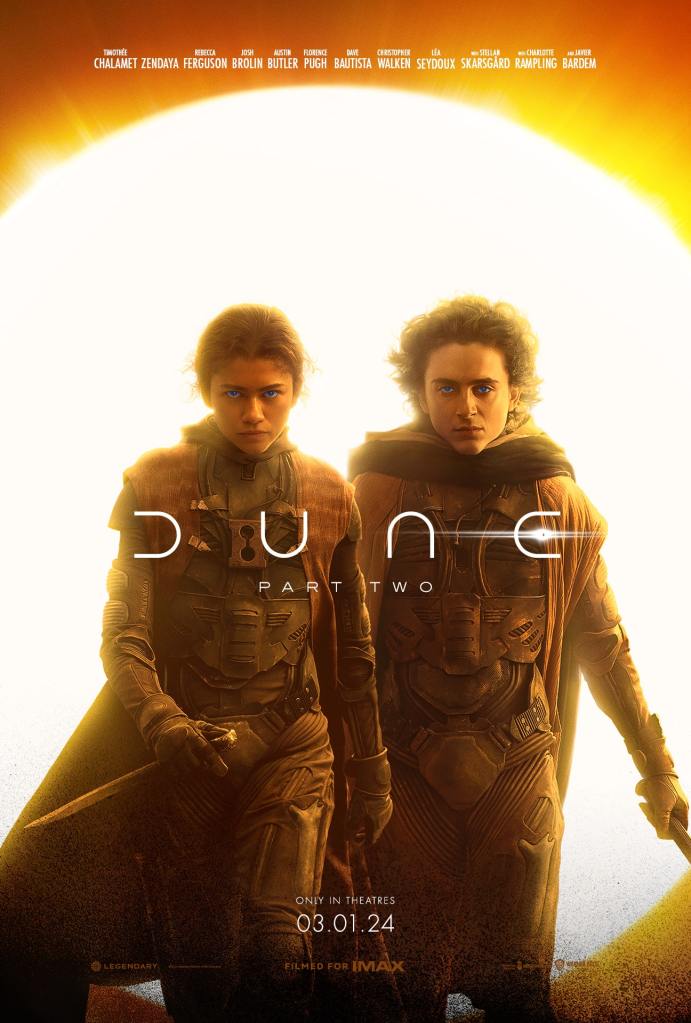
With Dune Part 2, Denis Villeneuve achieves the wonderful feat of an artistic and challenging film, one that is fresh and epic, while also performing the function of a Summer action blockbuster. It manages all this while at the same time remaining faithful enough to the source material to say it captures the spirit of the book. Not many films in the history of the medium can make that claim.
Although having said that, the film is not without its faults. The second half could have benefited with some expansion and room to breathe. It speeds through some major scenes and vital events like an express train past secondary stations. But then again, if it were longer I may be complaining that the film was “too” long for the theatre. Nevertheless it sticks its landing, and I would not be surprised if, after the release of the third part, Villeneuve’s final contribution to the saga, “expanded” versions were to be released on home-video, though Villeneuve does not make a habit of doing that (unlike Peter Jackson, Zack Snyder, Ridley Scott, Coppola, etc.). And I would hungrily add those to my collection.
Unfortunately, as I stated in my review of Dune Part 1, there are little flourishes of script work Denis Villeneuve misses out on. Moments, additions of barely 10-30 seconds that would have wrung the story thread for all it was worth. As I mentioned before, it is obvious the script of these three films was devised to form one consecutive narrative. So maybe, if watched one after the other the pay-offs work as intended. However, as the films are being released with a gap of atleast 2 years between them, they have to work as standalone films in the meantime. And they do, to a certain extent. With a couple of tiny tweaks these edges could have been bevelled. But these minor stumbles are few and far between. Even with them, the achievement of this film in its totality is awe-inspiring. So much so that, watching scenes of mind-boggling scope a feeling of shame swept over me – for judging David Lynch’s “failed” 1984 attempt so harshly all these years. Strangely, in watching the success of Dune Part 2’s execution, my esteem for Lynch, the maverick filmmaker, grew even more than I already held for his incredible filmography that includes the likes of Blue Velvet, The Elephant man and Twin Peaks. At his daring and especially his capability to wrangle what was achieved – for not only trying to mash the entire story that 5 hours of Dune Part 1 and 2 covers into a solitary film, but even a great chunk of the story to be covered in Dune Part 3. And on top of that, the blatant idiocy of producers to dictate that he do that in a runtime of little more than 2 hours! Watching the great battles here, scenes of people riding immense sand worms, rockets raining on mountains, crowds of thousands filling caverns, I applaud that he had the nerve to make it a reality over 40 years ago, in the days of primitive special effects. I will never look down on that film again as a failed attempt. No longer will it be a guilty pleasure, but a marvel to behold. These works of daring (leaps of fancy) are the things I crave, alongside my desire to be moved.
What elevates Dune Part 2 beyond a very good film to a landmark achievement is its sculpting of a landscape into the air around the viewer. The Sound Engineers of Dune Part 2 represent the film’s greatest artistic achievement that sits atop the heap of achievements of this stunning work. Like the wizards of ancient fables, they have summoned the powers of physics to create sensation. With sound! The Dolby Atmos of the IMax hall wriggled and writhed, trembled and quaked, the seat under by bum, the skin along my limbs. In one scene I felt the wind in my face atop a raging sand worm; in another I felt the thrum of the fluttering blades of an Ornithopter deep in my chest. No other film until this has affected me to such a degree with its exemplary use of a cinema’s speakers. Of course the music is heightened by these wizards. To call them Sound Engineers is to compare them to drivers of locomotives, pulling levers. No, they are more like the engine, tugging this film forward. Without them, if it is not experienced in an IMax hall in all its glory, I will declare that the film will be reduced significantly. That is not to take away its place as a powerful work of cinema, but the effectiveness they have achieved cannot be overstated.
The throaty tribal chants of the music work extremely well in the landscape of Dune. My only complaint, if any, and it is slight, is as with Dune Part 1, the electric guitar theme feels out of place among them and reminds me too much of Hans Zimmer’s own work in Man of Steel. Perhaps it will work better for those who are not going into the hall with that automatic association in their minds.
Having brought up Lawrence of Arabia earlier in my review, let me just say that it is a marvelous film. I first saw it in my mid teens when it came on TV. I saw it again on the big screen at various film festivals, but it wasn’t until I saw it for the tenth time, over ten years later, this time on a 70mm screen, that I realized I had never seen it at all. Oh, I had seen the pretty landscapes and the performances, bathed in the rousing Maurice Jarre score. But it was only the 70mm screen that transported me to the valleys of Jordan. To be among the party sweeping into the port of Aqaba swinging our sabres. And so it is with Dune Part 2. You need the combination of IMax and Dolby Atmos. And then that movie ticket you purchased will be magically transformed into your ticket 8000 years into the future, to a planet called Arrakis. And if you are lucky enough to experience that, then like me perhaps you too will stumble out of the theatre afterwards. And if a concerned passerby should ask whether you are alright, you can look them steadily in the eye and reply, ‘Walk without rhythm, and you won’t attract the worm.’
 Shot by Shot Reviews of Film and TV
Leave a comment